
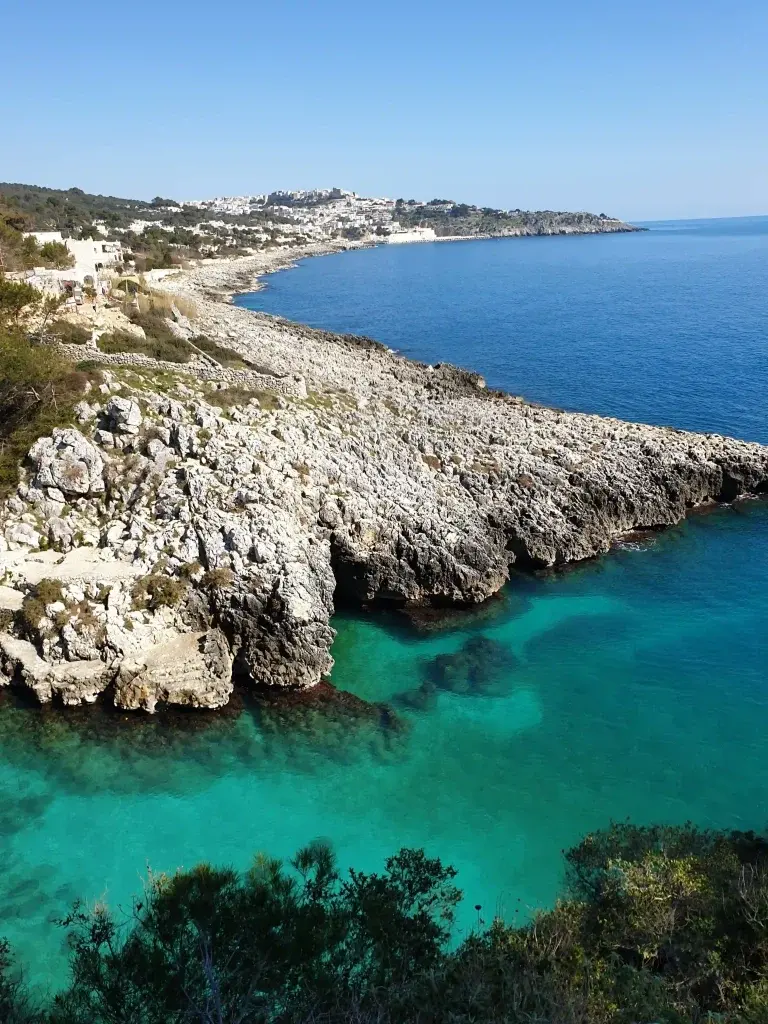
Among inaccessible caves, towers that defy time and the easternmost dawn in Italy
Start from Santa Maria di Leuca, where the Lighthouse greets you with its 47 metres of height. The Adriatic here is already different: jagged rocks, hidden caves and a wind that smells of wild oregano. Follow the coast northwards, and you will discover that every kilometre hides a secret.
1. Ponte Ciolo
A 30-metre-high bridge spanning a gorge carved by the Ciolo stream. Below, a beach of smooth white pebbles, surrounded by cliffs where swifts nest. The sea is cold and transparent, perfect for those who love adrenaline-filled dives. Curiosity: the name “Ciolo” comes from “ciole”, dialect for donkeys, which once carried goods along the paths.
2. Marina Serra
Here you find the Vora, a natural pool 8 metres in diameter carved into the rock. Access is free, but beware: in winter the waves fill it with brackish water, creating a natural Jacuzzi effect. Behind it, the Underground Oil Mill of Marina Serra (16th century) tells the story of Salento olive oil.
3. Tricase Porto
A small harbour where time seems to have stood still. The fishermen’s houses, low and ochre-coloured, still have nets spread out to dry. If you pass by in September, don’t miss the Sagra della Frisella: you will taste bread dressed with local tomatoes and menaica anchovies.
4. Grotta Verde
Warning: it is not accessible by boat! It can only be reached by swimming from the nearby beach. The interior is an underwater chamber where light filters through creating green reflections (thanks to the Ulva lactuca algae). Early in the morning, with the low sun, it feels like entering a dream.
5. Andrano and Acquaviva
- Andrano: in its historic centre, look for the little Church of San Domenico (12th century) with Byzantine frescoes. The coast offers Cala della Ripa, a beach of flat pebbles ideal for families.
- Acquaviva: the name does not lie: here a freshwater spring gushes into the sea. Swimming near the shore, you will feel the temperature contrast between the currents.
6. Castro
Two faces in one:
- Castro Marina: where the Grotta Zinzulusa (visitable with authorised boats) shows “rag-like” stalactites and brackish waters inhabited by rare blind crustaceans.
- Castro Superiore: a perched village with Messapian walls and a castle that was a refuge for bishops fleeing pirates.
7. Miggiano
A hinterland village known for the Carnevale della Puazza (papier-mâché masks that satirise the powerful). For trekking lovers: the Path of the Underground Oil Mills links ancient tuff quarries turned into oil mills in the Middle Ages.
8. Santa Cesarea Terme
The only natural sulphur springs in Italy that gush into the sea. The waters (32°C) are rich in sulphur and iodine, ideal for those with joint problems. Don’t miss Palazzo Sticchi (in Moorish style), which has dominated the coast since 1885.
9. Porto Badisco
A shell-shaped bay where, according to legend, Aeneas founded the first landing place in Italy. Today it is an EU Special Area of Conservation for Posidonia oceanica. Divers explore the Romito Wreck, a ship sunk in the 1960s, now home to moray eels and corals.
10. Torre Palascìa (Capo d’Otranto)
Italy’s easternmost point (18°31’22” E) is marked by a lighthouse from 1867. Coming here at dawn is a mystical experience: Italy’s first sun is mirrored on a sea that, on clear days, lets you glimpse the Albanian mountains.
11. Torre dell’Orso
The beach is famous, but few explore the Grotta di San Cristoforo (accessible by sea): on its walls, medieval graffiti depict ships and crosses. On the beach, look for the “heart pebbles”, smoothed by storms into romantic shapes.
12. San Foca
Here in 1480 the Turks bound for Otranto landed. Today it is a paradise for sailing enthusiasts thanks to the constant winds. Not to be missed: the underwater dry-stone walls, ancient fish traps now turned into oases for octopuses and starfish.
13. San Cataldo
The last stop before the San Cataldo Pine Forest (UNESCO heritage). The Bagno della Regina is a natural pool where, it is said, a Norman princess liked to bathe. The red lighthouse, 21 metres high, is still active and guides ships towards the Strait of Otranto.
Why is this stretch of coast unique?
- Protected biodiversity: 60% of the coast is a SCI (Site of Community Importance).
- Living history: from the footprints of the Messapians (8th century BC) to the Second World War bunkers visible at Porto Badisco.
- Raw flavours: in Castro, try the “mussu” (cured pig’s snout), a humble dish of peasant tradition.
The Salento Adriatic is not a coast: it is an open-air museum, where every wave tells a story and every rock hides a secret. 🌊