
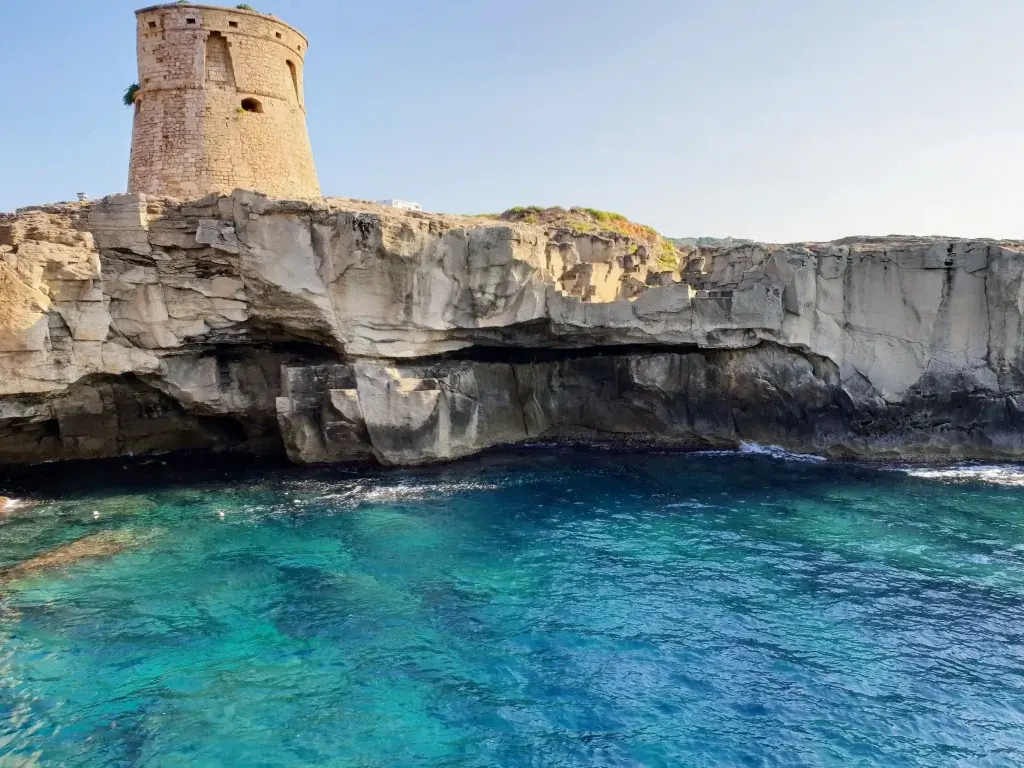
Imagine a chain of silent giants lined up along the 250 km of the Salento coast. These are the watchtowers, built between the 15th and 17th centuries to defend the land from the raids of Saracen pirates, Turks and corsairs. Today they rise like majestic scars, witnesses of battles, shipwrecks and legends that smell of sea salt.
Why Were They Built? Fear Turned to Stone
In the 16th century, Salento was a coveted target: its ports, olive groves and rich towns attracted Ottoman fleets. For this reason the Spanish (who ruled the Kingdom of Naples) ordered the construction of more than 80 towers, from Santa Maria di Leuca to Brindisi.
- They communicated with one another by fires and smoke signals: if a tower sighted enemy ships, within minutes the alarm ran along the whole coast.
- They were self-sufficient: they had water cisterns, weapons and even small vegetable gardens to withstand sieges.
Architecture: Sober Fortresses with a Secret
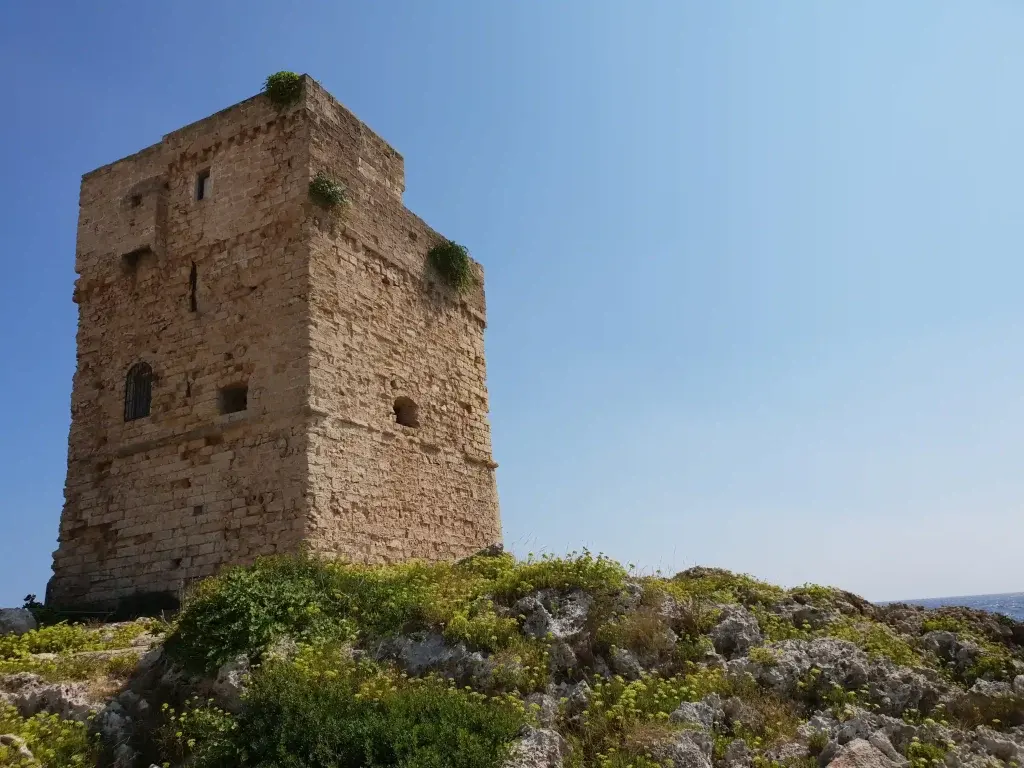
The towers were not elegant: they had to be functional.
- Shape: Almost all have a square or circular base, with walls up to 5 metres thick.
- Materials: Local limestone, quarried by hand from nearby quarries.
- Structure: Ground floor: storage for weapons and provisions, without windows. First floor: quarters for the soldiers, with fireplaces and arrow slits. Terrace: lookout point, where the alarm fires were lit.
- Secret: Many had external wooden staircases, which were pulled up in case of attack.
Iconic Towers: Stories That Withstand Time
- Torre Sant’Andrea Perched above the sea among cliffs sculpted by the wind, it is famous for the natural arch that frames it. It is said that the guards used a system of mirrors to reflect moonlight and communicate with friendly ships.
- Torre del Serpe (Santa Maria di Leuca) Its name comes from the legend of a sea serpent that, according to tradition, guided ships away from the rocks. The tower is half destroyed, but the base still shows the symbol of the reptile carved into the stone.
- Torre Lapillo (Porto Cesareo) One of the best preserved, with an original moat and graffiti left by the soldiers. Today it hosts cultural events: jazz at sunset, poetry readings, art exhibitions.
- Torre dell’Alto (Porto Selvaggio) Surrounded by a nature reserve, it can only be reached by a path among Aleppo pines and Mediterranean scrub. In the 17th century, the Spanish captain Diego Sandoval was killed here by an Algerian pirate: it is said that his ghost still watches over the coast.
- Torre San Giovanni (Ugento) The only one with a hexagonal plan, it was turned into a lighthouse in the 19th century. The internal spiral staircase is a masterpiece of Renaissance engineering.

What Makes These Towers Special?
- They are not all alike: some are massive and severe, others slender and almost decorative. Each architect left his own stamp, defying the military rules.
- They are open books: on the walls you can read Latin inscriptions, Templar crosses, dates of battles. At Torre Squillace, near Nardò, there is an inscription that reads: “Here the sea is ours, but the sky is God’s”.
- They have seen History go by: from the Ottoman invasions to the Allied landings of 1943, they have witnessed every chapter of the Mediterranean.
Today: Between Neglect and Rebirth
Many towers are ruins wrapped in ivy, others have been lovingly restored:
- Torre Pali (Ionian Salento): today a charming B&B, where you can sleep in a 16th-century room.
- Torre Nasparo (Tricase): home to a museum on the life of the tower-keepers, with reconstructions of weapons and logbooks.
- Torre Specchia Grande (Gallipoli): turned into an astronomical observatory, thanks to the clear skies of the coast.
Legends and Mysteries: When Reality Surpasses Fantasy
- Torre Uluzzo: it is said that a treasure of the Knights of Malta was hidden here, never found.
- Torre Porto Rosso: fishermen swear that on full-moon nights you can still hear the footsteps of Spanish soldiers.
- Torre dell’Orso: the legend of the Two Sisters (two rocks shaped like women) tells of two young women who drowned to escape a corsair.
Why Visit the Towers?
They are not just stones: they are bridges between past and present. Climbing a tower at sunset means:
- Feeling the wind that once carried enemy sails.
- Touching walls that have absorbed battle cries and prayers.
- Imagining guards scanning the horizon, hoping for peace.
Tip: Join a guided night-time visit. With a torch in your hand and the sound of the sea, history becomes as vivid as a film.
An Invitation to Discover Them
The towers do not ask to be admired, but listened to. Every crack, every stone, every wave breaking beneath them is a word of an ancient tale. And if you listen closely, perhaps you will still hear the echo of a drum sounding the alarm, or the sigh of a soldier dreaming of home.
Want a tailor-made itinerary? On our blog you will find a map with the 10 most fascinating towers, complete with GPS coordinates and secret stories. Because Salento is not simply looked at: it is explored with the eyes of courage.
The towers of Salento are not monuments: they are guardians of time. Respect them, and they will whisper stories that no book tells. 🏰🌊