
Salento is not a land, it is a palimpsest. Every people that has passed through it has left a mark: sometimes a scar, often a gift, always a story. To understand its soul, you have to imagine it as a centuries-old olive tree: Greek roots, Roman trunk, Byzantine crown, Spanish fruit. And a sap that is a blend of blood, sweat and salt.
The Messapians: the indomitable “first ones” Before the Greek colonists, there were they: the Messapians, an Italic people who built fortified cities (such as Lupiae, ancient Lecce) and worshipped deities tied to the earth. To them we owe the dolmens and menhirs that dot the countryside – stones raised like fingers towards the sky, perhaps astronomical calendars, perhaps altars. They were proud warriors: they resisted the Greeks of Taranto for centuries, until Rome absorbed them. Their legacy? The Salentine stubbornness that still says today: “Cu voli, pò” (who wants, can).
The Greeks: the sea turned into culture The Hellenic colonists (8th century BC) were not invaders but seeds. They brought vines, olive trees, and a way of thinking about the world that survives in Griko, the Greek-Salentine dialect still spoken in some towns. To them we owe the fogge, the water cisterns dug into the rock, and the art of making wine in the lame, natural valleys where vineyards grow sheltered from the wind. In towns like Gallipoli (“beautiful city” in Greek) or Galatina, the Greek heritage is a distant echo: in the capitals of the churches, in the dances reminiscent of the tarantella, in the cult of Saints Peter and Paul, Christian substitutes for Demeter and Dionysus.
Rome: roads, law and the first “globalisation” The Romans turned Salento into a corridor towards the East. The Via Traiana and the port of Brindisi were trade arteries, but their deepest influence was in law and agriculture. The rustic villas, ancestors of the masserie, became factories of oil and grain. Yet Rome here was less imperial and more peasant: the small rural temples dedicated to local deities, such as the goddess Thana, later assimilated to Diana, bear witness to this.
The Byzantines: monks, caves and sacred icons When the Western Empire fell (5th century AD), Salento became a frontier land. The Byzantines, with their obsession for the sacred, carved churches into the rock (like those of San Pietro in Otranto) and filled the countryside with frescoed cryptae. It was a mystical invasion: Basilian monks fleeing the iconoclast persecutions brought the cult of icons, the art of mosaic (see the Cathedral of Otranto) and a spirituality that mixed Christ with the rites of the land. In the towns, even today, the night-time torchlit processions recall Byzantine liturgies.
The Saracens: the terror that taught defence From 827 AD, the Arab raids marked Salento more than the dominations did. The Saracen pirates built no monuments, but they taught the Salentines to raise watchtowers (like Torre San Gregorio), to build houses with external staircases to escape the plundering, to hide grain in the neviere, underground pits. Their legacy? Words like “gebbia” (cistern, from the Arabic jabh), dishes like the fish couscous of Gallipoli, and that obsession with stone that makes the historic centres defensive labyrinths.
Normans, Swabians, Angevins: castles and Frederick II With the Normans (11th century) came the fiefs and the square-plan castles (like the one at Acaya). But it was Frederick II of Swabia, in the 13th century, who left the most vivid mark: a lover of Salento, a deer hunter in the forests of Oria, he built Castel del Monte (an esoteric icon 60 km from the coast) and promoted the fusion of Latin, Arab and Jewish culture. The Angevins, after him, brought French Gothic: try looking at the rose window of the Basilica of Santa Croce in Lecce… before the Baroque swallowed it.
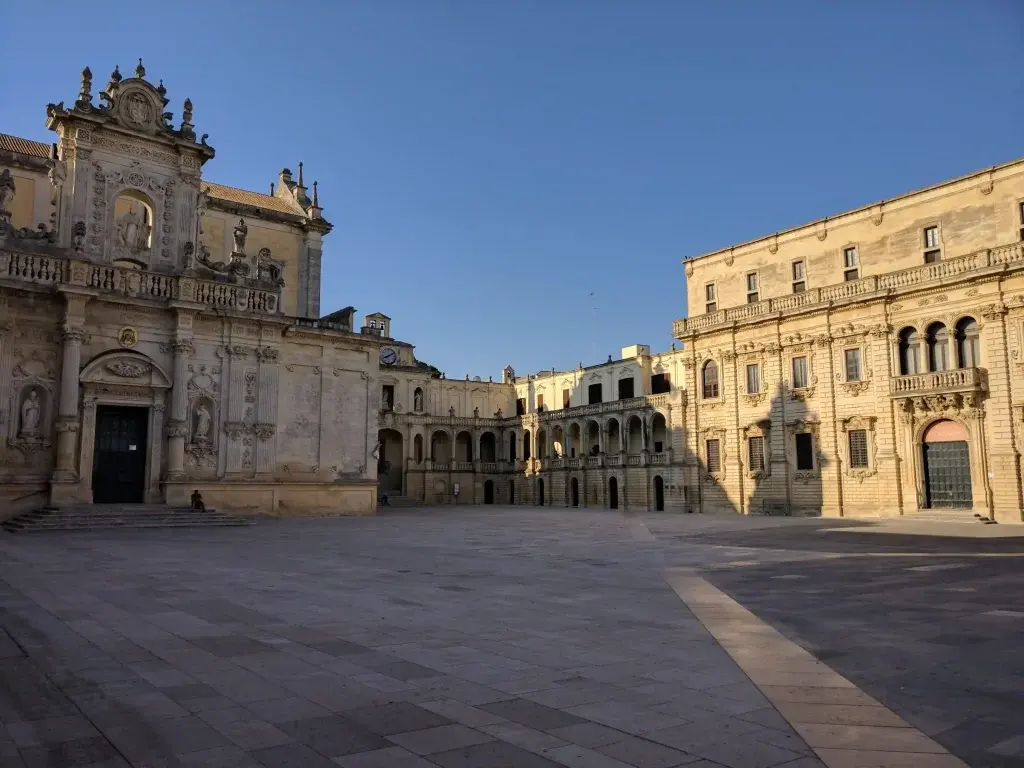
The Spanish: Baroque, theatre and the “festa” as rebellion From the 16th century, the Aragonese made Salento a land of conquest and taxes. But in response to Spanish oppression, the Baroque flourished: an exuberant architecture, full of gargoyles and stone flowers, as in Lecce. It was an act of resistance: instead of castles, the Salentines built churches that were theatres, with façades telling biblical stories as if they were comedies. The Spanish also brought a taste for the popular festival: the festive lights, the fireworks, the gaudy costumes of the village fairs are an Iberian legacy reworked in a pagan key.
The result? A melting pot that is not folklore, but DNA Today, all of this lives on in everyday gestures:
- When a farmer plants an olive tree, he does it as the Greeks taught him.
- When a grandmother lays out pasta on a cane rack (“massa“), she repeats a medieval gesture.
- When thousands of people dance the pizzica at the Notte della Taranta, they echo Greek healing rituals, Arab rhythms, the despair of farm labourers oppressed by the Spanish.
Why does the hinterland guard this heritage better than the sea? Because on the coast, the wind erases the traces. In the hinterland, Lecce stone – soft to carve, hard to destroy – preserves everything. In towns like Galatone, Cutrofiano or Soleto, every alley is an open book: here, a Norman portal merges with a Baroque balcony; there, a Byzantine crypt hosts a party with a DJ. Salento is not a museum: it is an open building site, where the centuries do not follow one another, but coexist.
And if today you feel that here “the Mediterranean breathes”, it is because every invasion was a wave that recedes, leaving shells of culture in the sand.